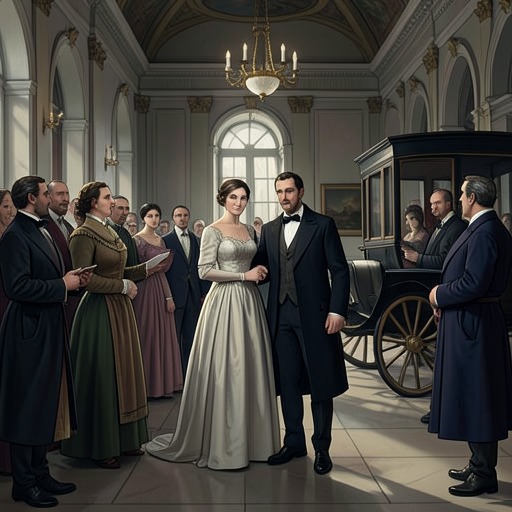
Klara Olsufyevna
The DoubleKlara Olsufyevna, the only daughter of Olsufy Ivanovitch, is celebrated as the “queen of the fete” at a lavish birthday dinner and ball. Her place in the story is defined less by an independently narrated account of her intentions than by the competing meanings others impose on her: Golyadkin reads her song as a message, later treats a purported letter as a plea to elope, and is finally brought before her father in a crowded drawing-room. Through these episodes, Klara becomes the center of Golyadkin’s social humiliation and increasingly confused understanding of events.
Identity and Introduction
Klara is introduced as the only daughter of Olsufy Ivanovitch, a civil councillor whom Golyadkin describes as his former benefactor and, in a sense, a father to him. Her birthday is the occasion for an unusually sumptuous dinner and a ball. The narrator sketches the event through its formal display: champagne, oysters, fruit, an elaborate toast led by Andrey Filippovitch, and the assembled guests’ attention to the birthday celebrant. Klara is presented as the ceremonial center of this celebration, not as its narrator or organizer.
The account emphasizes the scale and ritual of the gathering before Klara’s relationship with Golyadkin comes to the fore. At the toast, she is overcome by emotion and sinks into her mother’s arms. The narrator’s mock-heroic description of the feast and its guests contrasts with the precarious personal drama that will unfold within the same rooms: the party’s polished conventions make Golyadkin’s intrusion all the more conspicuous.
Golyadkin’s Reading of Her
Before the party, Golyadkin tells Krestyan Ivanovitch Rutenspitz that Klara had sung a song “with feeling.” He claims to have addressed her afterward, suggesting that her song had not been heard with a pure heart and hinting that her admirers were looking elsewhere. This report shows how readily Golyadkin turns an ordinary social performance into evidence of a hidden message. It establishes his tendency to interpret Klara through insinuation, although it does not independently confirm what she intended by singing or how she understood his remark.
At the ball, Klara is among the people Golyadkin notices as he pushes into a gathering to which he was not invited. He advances toward her while failing to register the guests he jostles and the disturbances he causes. When he reaches her, the assembled company falls silent and gathers around him. The scene makes Klara the immediate focus of his approach, but the narrative stays with his disorientation rather than supplying her thoughts.
After Golyadkin attempts to address Olsufy Ivanovitch, a polka begins and the attention of the party shifts to dancing. Vladimir Semyonovitch dances with Klara. When the dance ends and she sits down exhausted, the guests turn to congratulate her; Golyadkin then steps forward and imploringly offers his hand. Klara, taken by surprise, rises mechanically before he tries to dance with her. She cries out, and the crowd intervenes, separating them and carrying Golyadkin away from her. Her immediate response is clear, but the episode gives no further account of her view of him or of the incident.
The Purported Letter and the Elopement Story
Later, Golyadkin receives a letter bearing Klara’s name. In its text, the writer says that she is being married against her will, accuses a man who resembles Golyadkin of exploiting that likeness, and attributes a role in the supposed intrigue to her father. The letter asks its addressee to bring a carriage to Olsufy Ivanovitch’s home at nine that evening and promises that she will leave later in the night. It is signed “Klara Olsufyevna.” The narrative establishes that Golyadkin reads this document and reacts to it; the supplied episodes do not independently establish that Klara wrote it or verify the claims made in it.
The letter matters chiefly because of the certainty with which Golyadkin takes up its story. He treats it as proof that Klara wishes to escape with him and imagines a future meeting, while also voicing alarm about the legal and professional consequences of carrying off a young woman without her parents’ consent. His response shifts among imagined rescue, reproach, and blame. Rather than clarifying Klara’s intentions, the supposed letter exposes how thoroughly Golyadkin’s reading of her has become entangled with his fears about conspiracy, reputation, and his position in government service.
As he argues with himself over the supposed elopement, Golyadkin blames Klara’s upbringing: he speculates that indulgence and education at a boarding school taught by a French émigrée account for her supposed conduct. These accusations belong to his own agitated account, not to an independently confirmed history of Klara’s education or character. The episode therefore makes the gap between her limited presence in the narration and the elaborate story constructed around her especially pronounced.
Relationships and Final Appearance
Klara’s known family position is central to the birthday gathering: she is Olsufy Ivanovitch’s daughter, and her celebration brings the household and its guests together. At the party, she dances with Vladimir Semyonovitch, who is also present beside her at the story’s final tableau. The evidence shows these social arrangements, but does not establish a private relationship between them or confirm Golyadkin’s claims about whom Klara is to marry.
At the end of the supplied sequence, Golyadkin is led into a crowded drawing-room toward Olsufy Ivanovitch’s easy chair. Klara stands on one side of her father, pale and melancholy in a richly described dress, with a small white flower in her hair; Vladimir stands on the other side, dressed in black with a new order in his buttonhole. Golyadkin’s younger double is also there, composed and decorous, while Andrey Filippovitch stands nearby with a solemn expression. This arrangement brings the characters central to Golyadkin’s suspicions into one formal scene, but the account ends before it reveals what Olsufy Ivanovitch will say or whether the letter will be addressed.
Narrative Role and Significance
Klara’s importance in these episodes arises from the difference between her visible actions and the claims made in her name. She sings, dances, is startled by Golyadkin’s approach, and appears beside her father at the final gathering. By contrast, her supposed protest against marriage and plan to elope reach the reader through a letter whose authorship and truth are not independently confirmed. The narrative consequently requires a distinction between Klara as a person present in social scenes and Klara as a figure in Golyadkin’s interpretation.
The party’s choreography sharpens that contrast. First, a ceremonial toast places Klara at the center of collective attention; then, when Golyadkin approaches her, the dance and crowd redirect the room’s attention, and the guests remove him from the gathering. The later image of Klara beside her father and Vladimir again sets her within the household’s public arrangements, while Golyadkin’s double stands close by. The supplied evidence does not give Klara an extended independent voice, so the central question raised by her role is not answered through her testimony: the reader sees how Golyadkin turns her presence and the letter bearing her name into parts of his increasingly unstable account of the world.